
Get your lines tight with the Holy Diver when fishing for trout and rainbow trout!

For the undersigned, rapids fishing became a familiar form of fishing last year at Tainionvirta in Hartola. Fishing running waters with lures was an almost entirely unfamiliar territory for me, and it was interesting to learn how important it is, for example, to be able to read the rapids. Rapids fishing also differs greatly from traditional casting, because, for example, you have to work the technique a great deal to get the lure to swim exactly where the noble fish may be lurking. Rapids are also very often shallow and rocky, and the bottom has plenty of trees carried down by floods as well as other obstacles, such as extensive vegetation. Through rapids fishing I have also been able to test Ruthless Fishing's crankbaits extensively in rapids conditions, and the Ruthless Holy Diver in particular has proven to be an especially effective lure for catching trout and rainbow trout. Holy Divers imitating natural small fish have been a big hit, and the colour PINK has been the absolute number one.
It is also worth trying to tune your crankbait with the Orka Fish Roe beads found in our selection. These improve the catchability of crankbaits, especially in running waters that hold rainbow trout in addition to trout. The roe beads work as a strike point, much like a colourful hook, and the trout's diet includes rainbow trout roe in waters where both live. The bright colour does not go unnoticed by the fish either, and the roe beads offer the hooks a little protection from bottom vegetation.
A smaller 18mm version of this Holy Diver crankbait has now arrived in our Spring 2023 new product range. Grab the crankbaits from our online shop or from retailers and tune them with our Orka Fish Roe beads. After that, all that remains is tight lines!
-
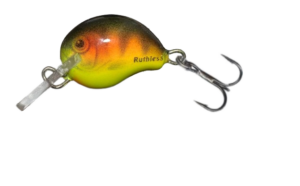 RUTHLESS HOLY DIVER 18mm9.90 €
-
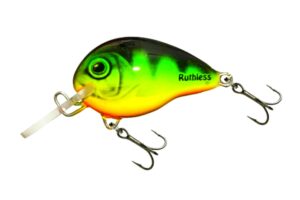 RUTHLESS HOLY DIVER 35mm9.90 €
-
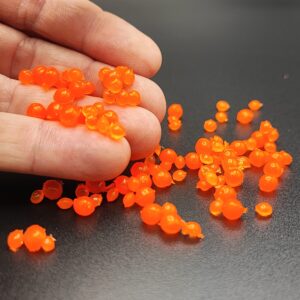 Orka Fish Roe roe balls7.90 €
Jake and Joonas headed to Tainionvirta to fish for trout with Ruthless Holy Diver crankbaits. Check out the video to see where the trout were found in such cool spring waters.
The video also reveals whether the pouring rain got the better of the guys or whether they persevered to the end. In the video you will also find general information about rapids fishing as well as essential details on the regulations. The video also shows what kind of equipment is worth using when going after noble fish, and a trout or two may have ended up in the video as well.
What equipment should you use for rapids fishing, and where are the fish found?
Rods intended for perch or pikeperch fishing work excellently in rapids fishing. However, a pikeperch rod rated at 10–30 g is already at the upper limit when targeting soft-mouthed noble fish. Micro-class perch rods are also an excellent choice for rapids fishing. Micro rods have a very sensitive tip and are usually extra fast in action, which is why even the smallest and lightest crankbaits and other lures fly accurately and far. A light open-face reel in the 1000–2000 size class is well suited. The lines may be fairly thin when using small and light lures: approx. 0.16–0.20mm for monofilament and approx. 0.08–0.13 for braided line. When using braided line, we recommend a long fluorocarbon leader, as braided line is extremely sensitive to abrasion and it is practically impossible to avoid rocks or other sharp objects on the bottom when fishing rapids.

When fishing rapids, finding fish requires at least a little ability to read the rapids, and you must master the techniques if you want to run the lure behind a certain rock or into a small side current. In cold water, trout and rainbow trout are found mainly in calm areas such as pools, the necks of rapids and tail-outs. However, you should always fish the cast to the end, even if the lure enters a stronger current. Noble fish very often follow the lure right up to the current, and a bite may well come precisely from the edge of the current. In the summer heat the situation is reversed. In warm water, noble fish try to find water that is as oxygen-rich as possible, which probably means the fish head deep into the foaming turbulence of the rapids. These contain pits and pockets that the fish favour, where the water is more oxygenated.
In general, all pits are the most effective fishing spots. However, it is always worth keeping your eyes open, as noble fish very often reveal their location by splashing. Attention should also be paid to landmarks that offer the fish either shelter or a place to lie in wait for food. These include the backs of large surface rocks, rock ridges, smooth patches or tails near a strong current, large bottom rocks, and broken trees hanging over the river, which have generally been effective spots. If you notice a fish splashing, you should not cast the lure directly “on top of the fish” but near it, where it can see it.
Of all the tools and aids, the landing net is probably the most important. Brown trout and rainbow trout are strong and slippery fish, so it can be difficult to get a proper grip on them. A landing net also makes wading considerably easier. If a fish, such as a brown trout, is released back, it should be touched with bare hands as little as possible, because the skin of a brown trout is very delicate and is easily damaged. The fish is also easier to handle when it is in the net and in contact with the water. Rainbow trout are very often taken home to eat, so a knife and some kind of priest (fish club) are also necessary tools. Thin, long-nosed pliers are also an important aid for removing hooks from the fish's jaws.
When fishing the rapids, you can catch other fish species in addition to rainbow trout and brown trout.

When heading to the rapids, many anglers target brown trout and rainbow trout, but in addition to these, pike and perch are also almost certain catches. Zander are also found in the lower stretches of larger rapids, where the rapids end in a lake or the sea. Especially in the heat of midsummer, zander may also move slightly further upstream, taking over the first deep pools they come across. As the water warms, pike and perch thrive in almost all slow-flowing areas or still pools of the rapids. These fish can already be found in large numbers in late spring in the lower stretches of the rapids, where, for example, vendace and smelt move up from the lake as soon as the water has warmed even a little. In addition, at dusk you may come across the ide, a member of the carp family. In flowing waters, ides often favour slightly slower-flowing areas with plenty of vegetation. When feeding, an ide may strike very aggressively, even at hard lures, and a good-sized ide offers a pleasant fight at the end of the line. Southern Finland's flowing waters also hide a predatory member of the carp family called the asp. This fish is fast and strong, and some have even called it the king of the cyprinids. Well-known fishing spots for large asp include Siuronkoski and Kuokkalankoski. Last but not least is Harri, or the grayling. Thanks to stocking, grayling can be fished almost throughout the country. In the fishing waters of northern Finland there are even reasonable natural populations, but elsewhere the grayling population is almost entirely stocked. This elongated salmonid is an excellent fighter on the line, and the surest places to look for Harri are slow-flowing rapids, the stretches between rapids, the heads of rapids and the deeper areas near flowing sections.
When fishing the rapids, always remember fishing permits and minimum size limits
It is important to remember that almost without exception, every rapid and recreational fishing lake requires a separate fishing permit. So when you go fishing at a rapid or, for example, at a so-called "rainbow trout pond", always find out in advance: where to get permits, how long one permit allows you to fish, how many fish you may keep for eating with one permit and how much the permit costs. In addition, especially at rapids, it is important to follow the rules of the site as well as the general and site-specific minimum size limits. Is wading prohibited at the rapids, do the rules state that only barbless hooks may be used, are there fishing-prohibited areas within the rapids, or is fishing allowed only at designated spots? You should also pay close attention to the closed seasons of different fish. In addition, it is important to know that, for example, brown trout is completely protected south of latitude 64º00´N. The minimum size of an adipose-fin-clipped, i.e. stocked, brown trout is at least 50 cm.


Jarno Kangas, social media influencer / Blogger
Latest Posts
-
 BLACK FRIDAY – THE MOST ANTICIPATED SALE WEEK OF THE YEARNovember 6, 2026/0 Comments
-
 CHRISTMAS GIFT IDEAS FOR ANGLERS – DISCOVER OUR SELECTIONNovember 6, 2026/
-

-
 Ruthless Fishing Hard Lures for SummerJune 26, 2026/