

–
The ABC of Ice Fishing – Quick Tips for Getting Started with Ice Fishing | The ABC of Ice Fishing – The Rise of Jig Fishing | The ABC of Ice Fishing – Tips for Ice Fishing Zander
Ice Fishing for Perch
Our national fish, the perch, has remained the most popular target species in ice fishing for generations, and for good reason. The perch is widely distributed and stays reasonably active even in winter. This also means that at times the ice angler has to be very active too, in order to find the actively moving fish. Feeding windows are also generally not very long. However, ice fishing for perch does not require much "skill", unlike, for example, ice fishing for a somewhat larger zander, so the perch, nicknamed the "striped shirt", is also a beginner-friendly catch.
Feeding spots for perch
The perch is widely distributed and water bodies vary in type, so it is natural that perch feeding spots also vary with the type of water body. In sea areas, good perch spots tend to be in somewhat shallower areas, such as the shallower bays. Vegetation and rocky areas have also been favoured by perch in sea areas; vegetation close to the shore and rocky areas slightly away from the shore are worth trying. Out at sea in deep water, you have to search a somewhat wider area and have some kind of local knowledge, otherwise catches may be limited to smaller perch.
Small, shallow lakes can be somewhat challenging. Here too, it is worth choosing vegetation and rocky areas, which provide shelter for perch, as your first targets. After that, it is worth trying deeper pits and shelves, and really any spots where there is even a little variation in depth if the lake or pond has a very flat bottom.
In larger and deeper lakes, perch are worth looking for on gentler slopes and in the mid-water between steeper slopes. Shallower humps near deep water or in the middle of it are also worth trying. In addition to these spots, headland points, deeper straits, shore vegetation and reefy areas are also good perch spots. It is also worth paying attention to the depth at which perch have been found or at which they have been most active, and concentrating your fishing on those depths.


What equipment should you use for ice fishing perch?

For ice fishing perch, ice fishing rods are primarily fairly soft, so that the hook-set is not too harsh for the soft-mouthed perch. With reel ice fishing rods, more sensitive rods also follow the perch's characteristic "shaking", so the fish cannot shake itself free of the jig. If your perch fishing focuses on larger perch, somewhat stiffer ice fishing rods or even zander rods can be used. When fishing with a mormyshka, however, it is recommended to use a mormyshka rod that always has some kind of bite indicator, with which even the smallest bites and nibbles can be seen. As line for ice fishing perch, 0.14–20 mm ice fishing line or fluorocarbon is recommended, and when fishing with mormyshkas alone the line can be considerably thinner. With ordinary ice fishing line, it is also recommended to use fluorocarbon as a leader before the jig, which provides protection against pike and zander. A leader is not strictly necessary, but then you should be prepared for losing lures if a pike or zander happens to strike. In perch fishing, the main auger size is 4–6″; note, of course, that if you use, for example, a live sonar, these generally need a hole of at least 8″. With the newly enacted revised fishing act, it is advisable to carry the appropriate tools for dispatching fish, so that fish taken for food can be killed quickly and properly. A priest and a knife are sufficient tools; smaller perch can of course be dispatched quickly by breaking their necks and snapping one gill arch open with a finger so that the fish bleeds.
Lures for Perch Ice Fishing
-
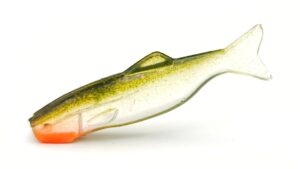 ORKA HYBRID SHAD 5 CM4.90 €
-
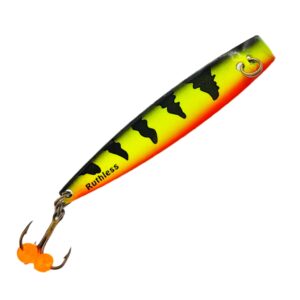 Ruthless Vertical Jig 65mm9.90 €
-
 Orka Fish Roe roe balls7.90 €
-
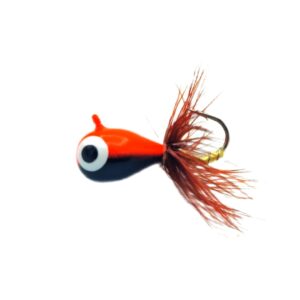 Ruthless Perhomorri 5mm / 1.8g5.90 €
-
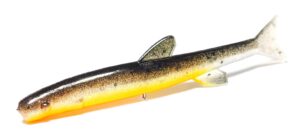 ORKA SMALL FISH 5 CM4.90 €
The selection of jigs for perch ice fishing is very wide. There are vertical jigs, mormyshkas, jigging lures, balance jigs and dropper jigs. There is no such thing as the one right perch jig; the choice of lure depends largely on the activity and size of the fish and on the body of water. However, a beginner perch angler's repertoire should include at least a mormyshka, a vertical jig, and a jigging lure or balance jig. This widens the range of lures so that there is a lure for perch of practically every size and feeding mood. Below, you will find a list of different jigs and the techniques for fishing them. It is also important to remember that these are guidelines, not the one and only right way. However, these instructions are based on the experiences of active anglers, who have, for example, used modern sonar technology, which reveals a great deal about fish behaviour. The best presentation technique, however, is the one that gets the fish to bite for you.
Jigs and Their Fishing Techniques
Balance jig and jigging lure:
These are the so-called lures for big perch, although with a slightly smaller balance jig or jigging lure, smaller striped ones can also be activated. Balance jigs and jigging lures are fished by working from the top downwards. For example, in eight metres of water, the jig is first lowered three metres below the ice. If there are no bites, it can be lowered a few metres deeper, and if there are still no bites, the jig can be lowered to about one metre above the bottom. The technique itself is based on long luring pulls that awaken the senses of the perch. At times you can also make slightly smaller pulls and shake the jig. If you have a sonar and notice a line rising from the bottom towards your jig in mid-water, keep your presentation as calm as possible, or hold the jig completely still. This applies especially in midwinter, when perch are generally quite wary at times. On spring ice, or when an active feeding window coincides with your fishing, the jig can be given a little speed in the same situation, making the lure imitate a fleeing baitfish. An active perch very often strikes a moving jig, but a perch in a passive feeding mood may rise several metres quite aggressively towards the jig, and once it reaches it, nothing happens and the fish simply stays there studying the jig. In that case, even a slightly too aggressive movement may scare the fish away completely.
Vertical jig and dropper jig:
The vertical jig is one of the most traditional perch jigs and works for perch of practically every size. Vertical jigs always have either a single or a treble hook, to which live bait is added (maggot / bloodworm). Especially when the fish are feeding passively, live bait can save the day in many situations. A dropper jig, in turn, is a jig where a dropper made of line is attached below a vertical jig or a similar lure (a sliding jig, a spoon or a flat lure), with a mormyshka at the other end. The jig then makes a hovering or searching movement and prompts the fish to strike the small mormyshka. With both vertical and dropper jigs, the jig is lowered slightly above the bottom and, if nothing happens, it can be raised a metre at a time. According to old habits and assumptions, the jig would be lowered straight to the bottom, where it would stir up the bottom to attract fish, but this very often scares the fish away. Occasionally, a few more curious individuals do come to see what is happening on the bottom, but shyer fish keep a good distance. This is not a wrong way either, and sometimes stirring up the bottom can be an effective way to draw fish over to investigate.
The presentation itself is based on slightly shorter pulls than with jigging lures and balance jigs, and the pulling cycles are more frequent than with those mentioned above. Shaking the jig with the ice fishing rod is also much more effective with vertical and dropper jigs. Although fishing with these jigs is somewhat more active, it is good to remember to take short pauses between the luring pulls, which makes the jig look more convincing to the fish.
Mormyshka
The mormyshka, or "morri", is the smallest of the ice fishing lures and requires the calmest presentation. The morri is the lure that comes into play when nothing else seems to work and the fish are feeding very passively. A morri is very often fished by dropping it to the bottom and then lifting it steadily upwards while shaking it. Even here, however, there are differences from one feeding mood to another in the depth at which, and the kind of presentation with which, the perch strikes. Sometimes the most passive perch will only take a morri quivering in place, and sometimes it strikes only after a lift and shaking of a few metres. The mormyshka is used with either a maggot or a bloodworm. With mormyshkas you should use ice fishing rods designed for them, which have some kind of mormyshka tip. Mormyshkas are very light in weight, and the faintest bites, especially from smaller perch, are easily missed with a bare fibreglass blank alone. For this reason, it is advisable to use rods equipped with a mormyshka tip, so that every bite can be noticed and reacted to.
PERCH ICE FISHING ON LARGE OPEN WATERS | 1.3KG | THE BIG PERCH OF PURUVESI | PREDATORS OF CLEAR WATER

Jarno Kangas, Fishing Content Creator / Blog Writer

Latest Posts
-
 BLACK FRIDAY – THE MOST ANTICIPATED SALE WEEK OF THE YEARNovember 6, 2026/0 Comments
-
 CHRISTMAS GIFT IDEAS FOR ANGLERS – DISCOVER OUR SELECTIONNovember 6, 2026/
-

-
 Ruthless Fishing Hard Lures for SummerJune 26, 2026/