
The ABC of Ice Fishing – Quick Tips for Getting Started with Ice Fishing | The ABC of Ice Fishing – The Rise of Jig Fishing
Ice Fishing for Zander
Zander is a passive and selective ice fishing species, and patience is one of the most important things when ice fishing for it. The zander's passivity describes both its hunting behavior and its movements. Unlike perch, zander is a much less active fish, so you should not abandon an empty hole at a promising spot straight away. At times you may have to sit at a hole for quite a while, but then the zander arrives, and soon 2–4 zander are lying on the ice, ready to be taken home for the dinner table. Because ice fishing for zander practically means sitting and wondering at the same hole for long periods, it is worth preparing for the trip with warm clothing and generous provisions.
Where to Find Zander
Good fishing spots naturally depend on where and when you fish, and it is also important to know which areas zander can possibly be found in. Spots that produced zander during the open-water season may work just as well in winter, but if they turn out to be empty, you should go looking for zander on drop-offs and on the broad, flat areas near them, where the depth is about 6–12 meters. As spring approaches, zander gradually begin to move toward shallower water. On spring ice, zander can even be caught in 1–3 meters of water, because in these areas they move to various shallow flats and spawning bays to feed on small fish before spawning. A hard bottom is also a favored area for zander and should be taken into account when choosing a spot. Like perch, zander are not sensitive to changes in air pressure, and it has very often turned out that zander become active precisely when the weather changes sharply and when people consider the weather bad. So you should not skip zander fishing even if it snows a little and the wind blows on the ice.


What Equipment and Techniques Should You Use for Zander?
For zander fishing, the equipment should be somewhat sturdier than for ordinary ice fishing. Zander has a hard mouth and requires firm, strong hook sets. For zander fishing you therefore need a rod that is stiff enough and does not yield completely when the zander strikes and you set the hook.

For the line, use 0.25–0.35 mm fluorocarbon or monofilament. For zander fishing, it is better to favor the former, fluorocarbon, because unlike monofilament it does not stretch. This helps with hook sets, as they become much firmer when the line does not give way to the counter-movement. In addition to the main line, it is also recommended to use a fluorocarbon leader one step thicker, which helps minimize lure losses to the zander's sharp teeth.
The ice auger should preferably be at least six inches (6″) so that even a larger zander can be brought up through the hole. When ice fishing, zander also tend to stiffen themselves crosswise just before the hole, and this is the most critical stage when it comes to losing the fish. It is therefore sensible to equip yourself with a sufficiently large auger to avoid last-minute losses.
In addition to this equipment, it is important to bring a fish measuring tape to confirm the length of the fish so that no undersized fish are taken. When you go ice fishing for zander, always check the water-body-specific restrictions and minimum size limits.
Lures for Ice Fishing Zander
-
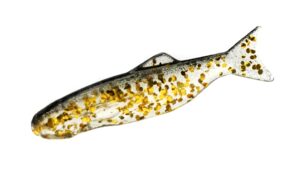 ORKA HYBRID SHAD 7 CM5.90 €
-
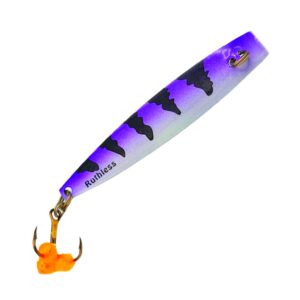 Ruthless Pystypilkki 85mm12.90 €
-
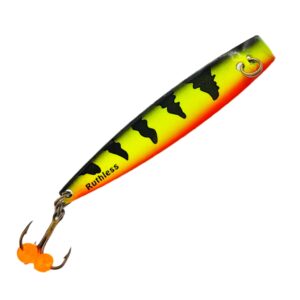 Ruthless Vertical Jig 65mm9.90 €
-
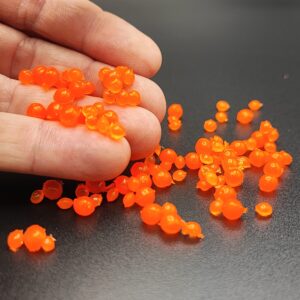 Orka Fish Roe roe balls7.90 €
-
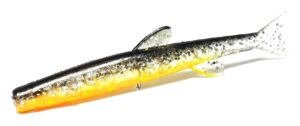 ORKA SMALL FISH 10 CM5.90 €
-
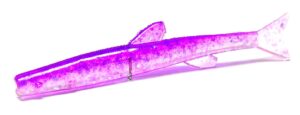 ORKA SMALL FISH 7 CM4.90 €
The best lures for zander are vertical jigs, ice fishing jigs and balance jigs. The right color and size always depend on the body of water, but as a general guideline, a length of 7–10 cm can be considered suitable for all the lures mentioned above. As for colors, it is impossible to name the “right” ones, especially as zander tend to be very color-sensitive and the right color may change several times. Even so, it is worth carrying natural colors and black-and-silver combinations. As a counterbalance, it is also worth investing in attention-grabbing colors; for example, yellow, orange, blue and purple can be effective. Zander fishing is also a peculiar discipline in that the color of the lure itself does not necessarily matter most, since zander are particularly fond of various colored hooks. So do not hesitate to try differently colored hooks on your vertical or balance jigs, or to customize your ice fishing jig with a colored hook. If changing colored hooks in the middle of fishing feels unappealing, you can also customize the colored hook you are using in under a minute with Orka Fish Roe beads, which are available in our selection in seven different colors.
A Sonar Is a Great Help in Zander Fishing
Zander can be a real challenge for ice fishermen, and without the help of a sonar, nearby fish may be scared away when technique and timing do not match. A sonar lets you assess whether there is any activity at a particular hole. If the sonar screen shows nothing but empty water even after half an hour, it may be advisable to move on and try another spot for a while. The sonar screen also lets you read any zander approaching your jig, so that you can adjust your jigging technique to suit the situation.

Which jigging techniques work for zander?
The same basic rule applies to ice fishing for zander as to all other fishing methods: there is no single right way. Even so, there are certain techniques that the majority of zander anglers rely on. The jig should be kept about 30–60 cm above the bottom, and the basic presentation can be relatively calm, with a longer pause between lure movements than in perch fishing. If no fish are visible, however, you should not shy away from slightly bigger lure movements, so that the lure attracts fish from as far away as possible. If activity can be detected, you should clearly tone down your jigging technique. When a zander is observing its prey, overly abrupt movements can very often drive the fish away. For example, if the sonar shows a possible target fish, you should keep the lure movement to an absolute minimum. At times the most effective approach may be to simply hold the jig still or to make a slight tremble.

Jarno Kangas, Fishing Content Creator / Blog Writer

Latest Posts
-
 BLACK FRIDAY – THE MOST ANTICIPATED SALE WEEK OF THE YEARNovember 6, 2026/0 Comments
-
 CHRISTMAS GIFT IDEAS FOR ANGLERS – DISCOVER OUR SELECTIONNovember 6, 2026/
-

-
 Ruthless Fishing Hard Lures for SummerJune 26, 2026/