
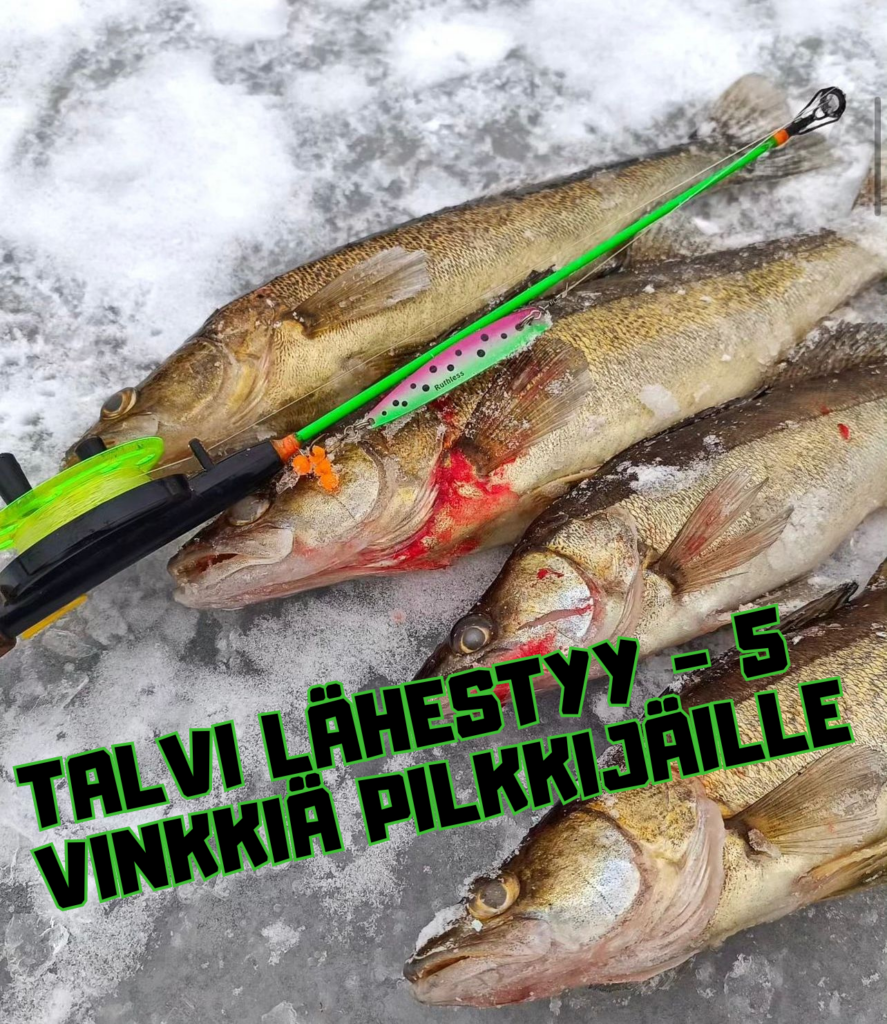
The weather is slowly turning frosty, and many of you are surely already looking forward to the ice. This article goes through five hints and tips to help you succeed on your ice fishing trip. Ice fishing can be enjoyed by anyone and almost anywhere, with a few exceptions. Winter fishing requires slightly more equipment than summer fishing, as ice fishing calls for a few essential items. The winters in our country can also pose challenges, as the ice is sometimes so thin that an inexperienced ice angler has little business being on it.
Preparing for the ice fishing season and for individual trips
The first fishing trips of winter or spring are usually the ones where half of the gear gets left behind, and things can be a bit chaotic amid all the anticipation and excitement. It is more pleasant to set off on the first trip when everything is in order and packed. Make sure the ice fishing rods have enough line and any tangles are sorted out, the auger blade or blades are in good condition, all lures and accessories are with you, and the ice picks are around your neck. It is also wise to prepare for individual trips, especially if the lake is not familiar to you. Make use of available map applications and aerial photos to find fishing spots. A sonar is also a great help in ice fishing, and today they are available across a very wide price range. If you do not have a pulk sled or your storage space for trips is limited, portable sonars are also an excellent solution. With these, you need to carry nothing more than a sonar the size of a floorball and your own phone, which serves as the sonar display.

Dare to try something new!
It is certainly easy to fall back on familiar and safe methods, even when the bite is very weak. Try letting your imagination be the only limit and try everything new, even the absurd. The undersigned, for example, has a rod with nothing but a pear-shaped weight attached, which can be used to bounce along the bottom. Many times, at a completely quiet hole, after stirring up the bottom properly with that rig, a large number of fish have come in from the side to gather beneath the hole. Try tuning your lures; for example, with many vertical jigs you can adjust the swimming action with just a pair of pliers. Or perhaps you have a jig that has always been a sure performer, but you would like to adapt it somehow for ice fishing. This is also how our winter novelty jig, the Orka Shad Hybrid, came about. Markus Huovinen developed the Hybrid Shad jig on an ice fishing trip by cutting the V-tail off a Small Fish jig and gluing it onto the body of an Orka Shad. During its very first days of fishing, the test model proved to be an extremely effective ice fishing jig for big perch and pikeperch.
Today, ice fishing in Finland has also expanded considerably beyond “traditional” ice fishing. Jig fishing through the ice is now strongly in the picture, and over the last couple of years American-style ice fishing with long rods and reels has gradually made its way to Finland as well. For perch fishing, for example, a long and very sensitive ice fishing rod paired with a size 500 open-face reel turned out to be a combo that made a previously unfamiliar style of ice fishing almost one of my favorites.
Dress warmly and keep yourself well fed
When you are dressed warmly and keep yourself well fed, ice fishing is more enjoyable and your concentration stays better. When cold and hunger strike, sitting on the ice is not necessarily so pleasant, and your focus on fishing may waver. Layered clothing is extremely important, and especially when moving on slightly weaker ice, a dry suit is almost an essential garment. Remember to always keep your ice picks around your neck and to check the ice. On spring ice, for example, when the sun is beating down, thaw holes hidden under the snow can be treacherous, although they are usually also easy to spot.
Change holes often
Perch in particular is a mobile fish, and a school may spread over a large area, so be sure to change holes or try different spots even if that hole has sometimes yielded large catches. There is, of course, a flip side to this: as mentioned, perch is a mobile fish, and if a hole has often produced good catches, patient waiting may bring the school right beneath you. But when exploring a new lake or unfamiliar places, actively changing spots pays off. My own basic rule is a maximum of 2 minutes per hole, or a few big lure pulls with a searching lure, such as a jig fitted with an ice jig head or a balance jig. If no traffic appears on the screen after the lure pulls and jiggling, it is best to move on to the next hole.
If you do not have a sonar, you can use methods such as the following:
Jig spoon – Lower the spoon straight to the bottom and begin lifting it from the bottom towards mid-water. In your own style, you can add small twitches and quivers at regular intervals between lifts.
Balance jig or jig lure – Lower the lure to mid-water and make a few larger attracting pulls as well as twitches, lowering the lure a little each time until it reaches the bottom.
Electric ice augers make drilling easier
Traditional hand augers are a reliably safe choice and, which is rare nowadays, many of them are made in Finland. Today a variety of electric augers are available, and they make winter ice fishing trips easier. After a dozen or so holes with a traditional hand auger, anyone will begin to feel it in the shoulders and arms. With an electric auger, by the 20th hole you can say, "that was easy and quick again". Electric augers are also available with a plastic thread, and their weights range from 1.6 to 2.2 kg. These models are very useful, for example, for those who carry a lot of gear with them, as every kilo shaken off the sled is a gain on the way home. Cordless drill and cordless driver augers are of course considerably more expensive than hand augers, but they make ice fishing much more pleasant, especially if you drill a dozen or so holes on every trip.


Jarno Kangas, Fishing Content Creator / Blog Writer
Latest Posts
-
 BLACK FRIDAY – THE MOST ANTICIPATED SALE WEEK OF THE YEARNovember 6, 2026/0 Comments
-
 CHRISTMAS GIFT IDEAS FOR ANGLERS – DISCOVER OUR SELECTIONNovember 6, 2026/
-
-
 Ruthless Fishing Hard Lures for SummerJune 26, 2026/