

The golden age of perch jigging is approaching | Read our current tips
September and October are the peak of the fishing season for many perch jig anglers. The waters are gradually cooling and the perch begin to feed up for winter. If you are not yet familiar with jigging, please read our guide to jigging. With the guides and tips found there, you will certainly be able to enjoy the best of what September and October have to offer for perch fishing.
Perch love small fish – Use this to your advantage when choosing a jig
In early autumn, occasional schools may still be found in somewhat shallower water, but gradually most perch begin to move out to the open water in pursuit of baitfish. The larger, "frying-pan-sized" perch in particular set off well in advance to chase small fish into deeper waters. For the most part, perch can be found in water 5-8 metres deep, and particularly good spots are the drop-offs near deep open waters.

Perch are indeed feeding up for winter and actively chase schools of small fish. It is therefore worth trying many different jigs that imitate small fish. In waters with ruffe and vendace, it is best to use slightly lower-profile jigs whose colour palette imitates these fish. If the waterbody has plenty of roach or other high-backed cyprinids, it is worth trying slightly higher-profile jigs; paddle-tail models, for example, are a very good choice. However, you should not completely ignore bright, irritant colours either, as these can very actively attract the attention of perch by standing out from the rest of the school of prey. Customising jigs is also a very effective method when using natural jigs among baitfish. For example, a small red mark where the imagined gill cover would be makes the jig imitate a wounded baitfish. You can also try colouring the belly side of the jig orange or red, for example, so that the jig imitates a vendace carrying roe.
You should not shy away from trying larger jigs for perch either. Especially when jigging among a school of baitfish, you sometimes need something that clearly stands out from the natural fish. In these situations, a considerably larger jig can make a big impact. Likewise, from among large schools of perch, even a really large jig can sometimes lure the biggest individuals to follow it and onto the hook.
-
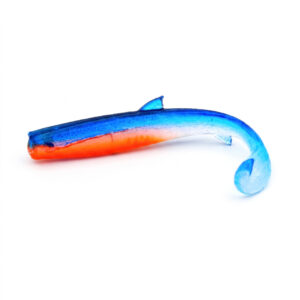 ORKA SMALL FISH PADDLE TAIL 5 CM4.90 €
-
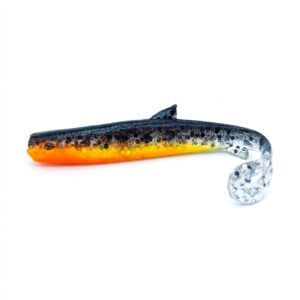 ORKA SMALL FISH PADDLE TAIL 10 CM5.90 €
-
 ORKA SMALL FISH 10 CM5.90 €
-
 ORKA SMALL FISH 7 CM4.90 €
-
 ORKA SMALL FISH 5 CM4.90 €
-
 ORKA SHAD 9 CM5.90 €
-
 ORKA SHAD 7 CM4.90 €
-
 ORKA SHAD 5.5 CM4.90 €
Feeding times and fish activity can change very quickly
In early autumn, early mornings and evenings accompanied by the sunset can prove to be good times for jigging perch. Baitfish are very active in the mornings and evenings, which also activates the predatory fish. However, the days begin to shorten very quickly the further into October you go, at which point the best times are the bright hours of the day.
The lower amount of light is also reflected in the behaviour of the perch, and especially toward the end of October, perch can become very selective. When the perch clearly start to become passive, it is worth using a slightly lighter jig head than usual and a more passive retrieve. Different jigging and rigging techniques can also bring relief in difficult moments. Drop shot jigging or the Cheburashka rig in particular can be lifesavers on tough days.
You can read more about different jig rigs via this link


Jarno Kangas, social media influencer / Blogger
Latest Posts
-
 BLACK FRIDAY – THE MOST ANTICIPATED SALE WEEK OF THE YEARNovember 6, 2026/0 Comments
-
 CHRISTMAS GIFT IDEAS FOR ANGLERS – DISCOVER OUR SELECTIONNovember 6, 2026/
-

-
 Ruthless Fishing Hard Lures for SummerJune 26, 2026/