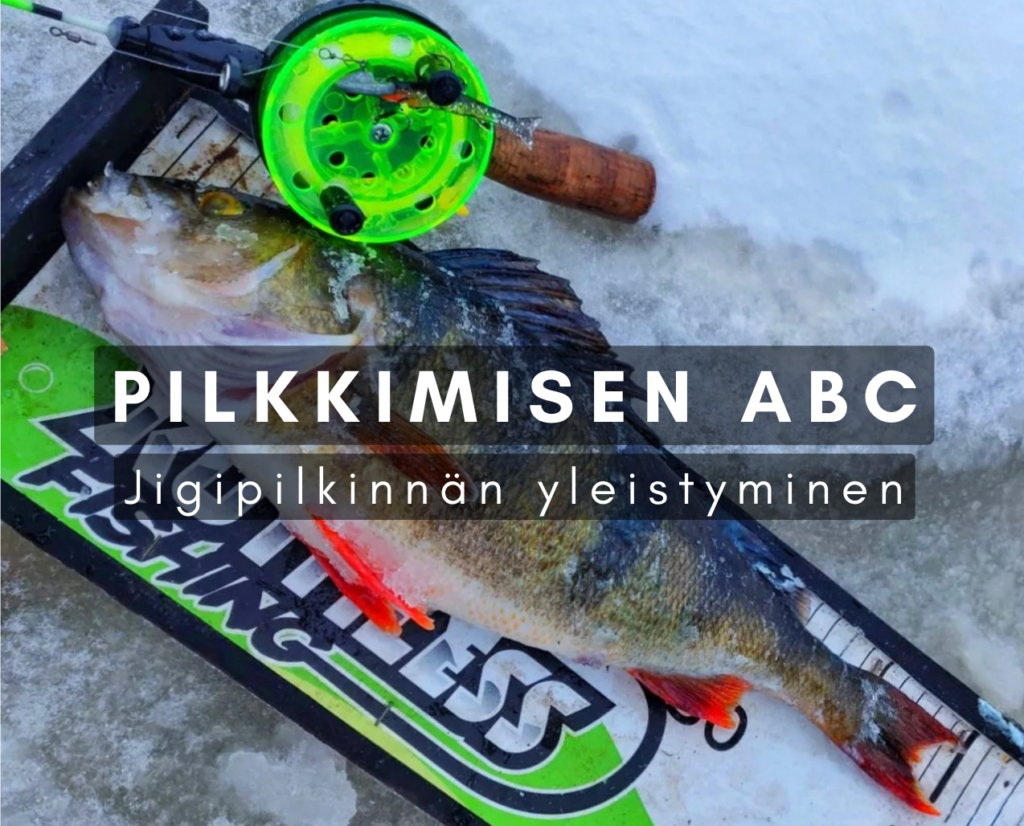
The ABC of Ice Fishing – The Rise of Jig Ice Fishing
What is jig ice fishing?
Jig fishing has grown enormously in popularity in recent years, and jig ice fishing in particular has captured people's interest alongside traditional forms of ice fishing. Jig ice fishing is comparable to vertical jigging, and it is best to favour vertical jigs or jigs with a passive swimming action. Jig ice fishing itself is no rocket science, and the technique is entirely comparable to fishing with a balance jig. To get started with jig ice fishing, all you need is an ice fishing rod with a firm tip, plus ice fishing jigs and matching ice jig heads. A sonar is, however, a great help in jig ice fishing, but we will return to that aspect in more detail in another article. Below you will find instructions and tips for jig ice fishing.
Jig ice fishing is an easy and effortless form of fishing, and anyone can pick up its tricks during their first day on the ice.
Joonas Väntti
What kind of jigs should be used for jig ice fishing?
In jig ice fishing, it is best to favour vertical jigs or jigs with a passive swimming action. An excellent choice for a jig is the Orka Small Fish available on our website, which you can also find at our retailers across Finland. These jigs have earned a strong reputation among jig ice anglers, and numerous perch records have been broken with them! Ice fishing jigs can also be tuned yourself. For example, if you want to make the swimming action of a lure even more passive, a small piece can be cut off the tail end. You can also try modifying lures with jig markers. The undersigned in particular has noticed that a red line on "natural" coloured jigs has at times been especially appealing from the fish's point of view. The red line imitates a wounded fish, which awakens the instincts of predatory fish. It is also worth trying to attach a treble hook to ice fishing jigs. This improves the jig's hooking ability and catch rate. It also works as a strike point, especially when perch are feeding poorly and only nip at the tail.
You can find the Orka Small Fish via this link
You can find a video on attaching a treble hook to ice fishing jigs via this link.
We have developed Orka Small Fish jigs designed especially for jig ice fishing, along with the separately manufactured Ruthless Ice Jig Head ice jig heads. With this combination, you can make the jig swim in the water just like a balance jig.
Joonas Väntti
What kind of jig heads should be used for jig ice fishing?
Ordinary jig heads can be used for jig ice fishing, but in winter it is best to favour tungsten for traditional jig heads. However, ordinary jig heads create almost no side-to-side movement for the jig, which is why I personally recommend using Ruthless Fishing's Ice Jig Head ice jig heads, which I have used exclusively since the very first test. It is a jig head designed for ice fishing, with a swimming action that awakens the hunting instinct of predatory fish. The jig head's precise balancing makes the jig swim in long, irregular glides from side to side, much like a balance jig, provoking the fish to strike. In other words, the Ice Jig Head makes the jig imitate a fleeing small fish.
You can find the Ruthless Ice Jig Head ice jig heads via this link
How do I work an ice fishing jig?
Working an ice fishing jig is very similar to fishing with a balance jig, but here too there is no truly correct way. It is worth finding the style that suits you and trying different techniques with fish in different feeding moods. If you are trying jig ice fishing for the first time, however, you can get started with these tips.
First lower the jig into mid-water, and in the best case the fish will strike already at this stage. A sonar is a great help here, as you can see how the fish react to your ice fishing jig. If simply lowering the lure does not spark any interest, it is worth making a few enticing lifts and watching how the fish react. If there is no reaction, repeat this step until you are close to the bottom. When you notice a fish slowly rising to inspect your jig, you can twitch it gently while slowly lifting the jig upwards. At times the fish are completely passive or very picky, and then it is worth actively trying different colours and sizes. Once you find the right colour and size, fish will certainly come up onto the ice. If you are using a sonar and have gone through your entire colour arsenal, yet the fish still do not seem to bite, do not become too fixated on the fish visible on the screen, but try another hole instead. Sometimes the fish are simply completely passive, and soon you notice that you have spent quite a while staring at the screen and playing cat and mouse, so remember to actively look for active fish as well.
Which hook size suits which jig?
- Hook size #4: Orka Small Fish 3 cm
- Hook size #2: Orka Small Fish 5 cm
- Hook size #1: Orka Small Fish 5 cm & 7 cm
- Hook size 1/0: Orka Small Fish 7 cm
- Hook size 2/0: Orka Small Fish 7 cm & 10 cm
- Hook size 3/0: Orka Small Fish 10 cm
Which jig head weight for which depth?
- Ice Jig Head 5g: 3-5 cm jigs / Fishing depth: 0.5-2 metres
- Ice Jig Head 7g: jigs of 5-7 cm / Fishing depth: 2-5 metres
- Ice Jig Head 10g: jigs of 6-10 cm / Fishing depth: 5-9 metres
- Ice Jig Head 15g: jigs of 7-15 cm / Fishing depth: 5-20 metres
With these guidelines, you can easily choose the jigs and ice jig heads that suit your own fishing needs.
Watch Joonas's tips for jig ice fishing in the video below!
@ruthlessfishing This is how you work an ice jig!#foryou #suomitiktok #rainbowtrout #whitefish #ruthlessfishing #seoruutlessii #perch #fishing #pike #jigfishing
♬ original sound – RuthlessFishing
Text written by: Jarno Kangas, social media influencer
Photos and videos: Joonas Väntti, Ruthless Fishing
Tight lines to all!
You may also like
Categories
- PERCH FISHING
- CLEARANCE
- SUNGLASSES
- BLACK FRIDAY
- LANDING NETS
- PIKE FISHING
- JIG HEADS / WEIGHTS / HOOKS
- ZANDER FISHING
- GIFT IDEAS
- GIFT CARDS
- SPOONS AND HARD LURES
- MEASURING STICKERS AND LOGO STICKERS
- OTHER PRODUCTS & SERVICES
- ORKA JIG PRODUCTS
- ICE FISHING
- RUTHLESS BOATS
- LINES & LEADERS
- ACCESSORIES
- Uncategorized
- WOBBLERS
- CLOTHING
- RODS & REELS
- LURE ASSORTMENTS
- LURE SNAPS
- TACKLE BOXES
Latest Posts
-
 BLACK FRIDAY – THE MOST ANTICIPATED SALE WEEK OF THE YEARNovember 6, 2026/0 Comments
-
 CHRISTMAS GIFT IDEAS FOR ANGLERS – DISCOVER OUR SELECTIONNovember 6, 2026/
-
-
 Ruthless Fishing Hard Lures for SummerJune 26, 2026/