

A warm summer evening, a shallow area adorned with rocks and vegetation, and the most delicate fishing tackle. Every slightest bite is transmitted to your hand through the thin line and the light jig. A sizeable perch that has taken your lure bends your rod and your pulse begins to rise. This style of fishing offers you wonderful moments in both perch and pikeperch fishing.
-
 ORKA SHAD 3.5 CM
-
 ORKA SHAD 4.5 CM
-
 ORKA SHAD TAIL 5.5 CM
-
 ORKA SMALL FISH 3 CM
-
 ORKA SMALL FISH 5 CM
-
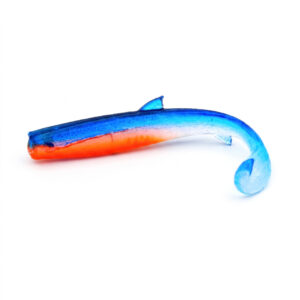 ORKA SMALL FISH PADDLE TAIL 5 CM
-
 Ruthless 8-Braid braided line 115m
-
 Ruthless Fluorocarbon Leader
-
 Ruthless Slim Keeper Jig Head 3g
-
 Ruthless Slim Keeper Jig Head 4g
-
 Ruthless Slim Keeper Jig Head 5g
-
 Tungsten Slim Keeper Jig Head 3g
-
Tungsten Slim Keeper Jig Head 5g
What Is Microjigging?
Microjigging is based on traditional jig casting, but the lures and equipment used in this style of jig fishing are considerably lighter. Microjigging is at its best in shallow water during warm-water periods, when both perch and pikeperch can be reached in the shallows. The optimal depth for microjigging is 0.5–2 metres, but it also works in somewhat deeper water when the fish are in mid-water or near the surface. Microjigging is also a pleasant style of fishing because the range of fish you can catch is much wider than, for example, in traditional jig casting. Microjigging often focuses on areas where a wide variety of cyprinids can also be reached, so you should be prepared for a bream weighing over a kilo deciding to test the backbone of your light rod.
What Kind of Equipment for Microjigging?

You will get the best experience from microjigging when you have equipment designed for it. Your most important “tool” is the rod, which should have a fully tip-action taper and a recommended lure weight of 1–13g. The market also offers extremely sensitive UL rods with a very low recommended lure weight, which suit slightly smaller and average-sized perch. However, if your goal is larger perch or pikeperch in shallow water, it is not necessarily worth picking the flimsiest UL rod from a supermarket, although here too the angler's own preferences naturally play a strong role.
- The undersigned recommends the Ruthless Rods Micro rod from our selection as the rod for microjigging.
UL and micro rods are generally very light in weight, and in microjigging the aim is to maximise feel and sensitivity, so the best-suited reel is a 500–1000 size open-face reel or a very light baitcasting reel. The downside of a baitcasting reel, however, is that using jig heads of this weight class optimally can cost a great deal with a baitcasting reel.
- As the reel for microjigging, the undersigned recommends the Abu Garcia Superior 1000S open-face reel, which is also found in the undersigned's own microjigging set. This reel is also available in our product range.
In microjigging, the line and the fluorocarbon also matter greatly when you want to maximise the feel of the lure and of bites. The line used is a braided line 0.06–0.10 mm thick. The thinnest braided lines give maximum feel, but these lines are barely forgiving at all when it comes to bottom contact. If perch is the target fish, using a fluorocarbon leader is not necessary. This preserves the feel provided by the thin braided line, and the swimming action of small jigs fitted with light jig heads does not suffer. If you are targeting pikeperch, or there may be many pike in the area, it is advisable to use a fluorocarbon leader.
What Kind of Jigs and Jig Heads for Microjigging?

The jigs used in microjigging are generally under 5 cm in size. Jigs can be paddle tails, sickle tails, V-tail dead-swimming jigs, crayfish, grubs or even twisters. Personally, in microjigging I favour very small paddle tails and slim-bodied jigs, such as the Orka Small Fish and Orka Paddle Tail jigs found in our selection.
Jig heads weigh at most about 7 grams. Tungsten jig heads work particularly well in microjigging, because tungsten is a material 70% denser than lead and sinks considerably faster in water than lead. When fishing with a tungsten jig head, the weighted head can be significantly lighter and smaller than a head made of lead. Tungsten is a very hard material compared to lead, and it gives the angler an unprecedented feel of both the lure and the bottom structure of the area being fished. Thanks to their small size, tungsten jig heads are excellent for use with slim-bodied jigs. Tungsten is also an environmentally friendly material and does not dissolve in water like lead. Micro jig heads designed specifically for microjigging are also an excellent fit, but you can also use ordinary jig heads.
How Do I Find Places for Microjigging?
The same location tips apply to microjigging as to shallow-water hardbait fishing. You will find these tips in our fishing article “Perch from Shallow Water | How Hard Lures Work”. If you prefer not to interrupt reading this article by opening the link above, the best places to look for microjigging bites are, in broad terms, the following:
- Rocky and weedy shallows
- Shallow straits and points
- Shallow-water reefs and reefs close to deep water
- Shallow drop-off edges and larger humps


Jarno Kangas, social media influencer / Blogger
Latest Posts
-
 BLACK FRIDAY – THE MOST ANTICIPATED SALE WEEK OF THE YEARNovember 6, 2026/0 Comments
-
 CHRISTMAS GIFT IDEAS FOR ANGLERS – DISCOVER OUR SELECTIONNovember 6, 2026/
-

-
 Ruthless Fishing Hard Lures for SummerJune 26, 2026/